
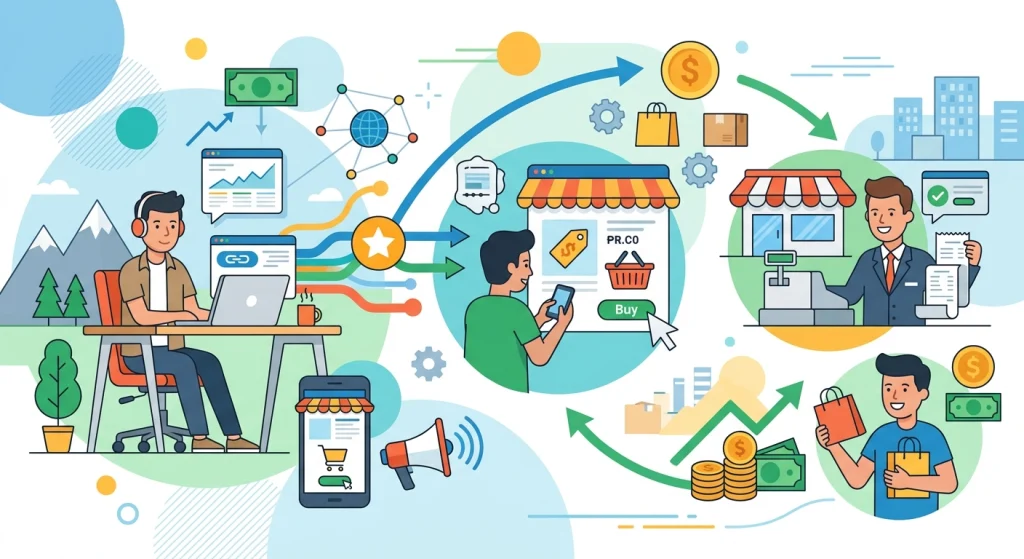
So you’ve heard people are making a full-time income just by sharing links. Sounds too good to be true, right? I thought the same until I accidentally earned my first commission while recommending a pair of running shoes to a friend. That’s when it clicked: affiliate marketing isn’t magic, but it is one of the smartest ways to earn passive income — if you understand how it really works. Let me walk you through the real deal, no fluff, no fake guru promises.
What Is Affiliate Marketing? (And Why You’ve Already Seen It)
Affiliate marketing is simply earning a commission by promoting someone else’s product or service. You share a special link (affiliate link), someone clicks it and buys, and the merchant pays you a cut. Think of it as getting a finder’s fee for a good recommendation.
Real-life comparison: Imagine you tell a neighbor about the best pizza place in town, and the owner gives you 15% of the bill. That’s affiliate marketing, but online.
Key players in the game:
- Merchant – the brand that creates the product (Amazon, Shopify, Coursera).
- Affiliate – you, the person promoting the product.
- Customer – the one who clicks your link and buys.
- Affiliate network – a middleman that connects merchants and affiliates (ShareASale, CJ Affiliate, Impact).
How Affiliate Marketing Really Works Behind the Scenes
Here’s where most beginner guides get vague. They say “just post a link and earn,” but there’s a precise flow. Let’s break it down.
Step 1: You join an affiliate program
You sign up for a program or network. Some approve instantly (Amazon Associates), others review your website or social media first.
Step 2: You get a unique tracking link
That link has a cookie – a tiny tracker that remembers the customer for a set period (24 hours to 90 days, depending on the program).
Step 3: Someone clicks your link
Even if they don’t buy right away, the cookie stays active. If they return a week later and purchase, you still get the credit.
Step 4: You earn a commission
Commissions range from 1% (electronics) to 50% or more (digital courses, software, high-ticket coaching).
But here’s the catch: If the customer clears their cookies or buys from a different device, you might lose the sale. That’s why you need volume and trust, not just links everywhere.
Types of Affiliate Marketing (Which One Fits You?)
Not all affiliate marketing looks the same. Based on my experience, beginners should start with one of these three models.
1. Unattached affiliate marketing
You promote products without any connection to the niche. Example: running Google ads to a product you’ve never used.
Low effort
Requires ad budget and trust issues
2. Related affiliate marketing (sweet spot for most)
You recommend products in a niche you genuinely care about. If you love hiking, you promote backpacks, boots, and water filters.
Higher conversion rates because of trust
Takes time to build an audience
3. Involved affiliate marketing
You’ve used the product, made a case study, or created a tutorial. Think tech reviewers or cooking bloggers.
Maximum trust → higher commissions
Requires deep product knowledge
Life hack: Start with “related” marketing. Pick one hobby or problem you understand better than the average person. That’s your goldmine.
How Beginners Actually Make Money (Without a Huge Following)
I hear this all the time: “But I only have 200 followers.” Good news — you don’t need millions. You need the right strategy.
Three realistic starting points:
1. A niche blog
Write reviews, “best X for Y” lists, and tutorials. Each post includes affiliate links naturally. Example: “Best budget microphones for podcasters.”
Time to first commission: 3–6 months
Money needed: ~$40/year for hosting
2. YouTube channel
“Unboxing” and “honest review” videos convert like crazy. Put affiliate links in the description.
Time: 2–4 months
Money needed: smartphone + basic editing software
3. Email newsletter
Build a tiny but engaged list around a specific pain point (e.g., “weekly productivity tools”). Each email ends with 1–2 relevant affiliate offers.
Time: 1 month to start earning
Money needed: $0–$20/month for email tools
Real example:
A friend of mine started a simple website reviewing gardening tools. No fancy design, just honest opinions. Her first month: $47. Sixth month: $1,200. Her secret? She answered real questions like “Which pruner won’t hurt my wrists?” That’s the magic.
What Nobody Tells You About Affiliate Commissions
Let’s talk numbers because most beginners overestimate what they’ll earn and quit too soon.
Typical commission structures:
- Physical products: 1%–15% (Amazon starts at 1–10%)
- Digital products: 20%–50% (courses, software, templates)
- High-ticket items: 30%–50% (coaching, SaaS, luxury travel)
- Subscription products: recurring commission (e.g., 30% every month the customer stays)
Example math:
You promote a $100 online course with 40% commission. You need 25 sales to earn $1,000.
But if you promote a $10 physical product with 5% commission, you’d need 200 sales for the same $1,000.
See the difference? That’s why many pros push digital products. But here’s the trade-off: digital products require more trust. You can’t sell a $300 course to someone who just met you.
Pro tip: Mix one high-commission digital product with two low-cost physical products. The physical ones build trust; the digital one pays the bills.
Common Affiliate Mistakes That Kill Your Earnings (Avoid These)
I’ve made every single one so you don’t have to.
Mistake #1: Promoting everything that pays
Your blog becomes a junkyard of random products. Result? No trust, no clicks.
Fix: Stick to one niche for at least 6 months.
Mistake #2: Hiding your affiliate links
If you never say “this is an affiliate link,” you’re legally in trouble (FTC requires disclosure) and morally shady.
Fix: Write “I may earn a commission” naturally at the start of a post or in a video description.
Mistake #3: Ignoring the “middle of the funnel”
Beginners only target buyers ready to purchase. But most people are just researching.
Fix: Create content for “best X under $50” (buyers) AND “how to choose X” (researchers).
Mistake #4: Quitting after two months with $0
Affiliate marketing is a slow burn. Month 1–3: building. Month 4–6: small wins. Month 7–12: real traction.
Fix: Commit to 12 months before judging results.
How to Choose Your First Affiliate Program (Without Overthinking)
With thousands of programs out there, beginners freeze. Here’s a simple 3-filter system I still use.
Filter 1 – Relevance
Does this product solve a problem for your audience? If you write about fitness, don’t promote cookbooks for diabetics unless that’s your sub-niche.
Filter 2 – Cookie duration
Short cookie (24 hours) = you must sell immediately. Long cookie (30–90 days) = more forgiving. As a beginner, aim for 30+ days.
Filter 3 – Commission rate
Below 10% for physical products is normal. Below 5% is only worth it if the product price is high ($500+).
Beginner-friendly programs to check:
- Amazon Associates – low commission but highest conversion because people trust Amazon
- ShareASale – wide variety of merchants, good for blogs
- CJ Affiliate – big brands, stricter approval
- ClickBank – mostly digital, high commissions (but vet products carefully)
- PartnerStack – SaaS and B2B tools
The Hidden Power of “Best X for Y” Pages
If you only create one type of affiliate content, make it comparison or “best” articles. Why? Because they capture people ready to buy.
Example headline: “Best Noise-Canceling Headphones for Remote Workers on a Budget”
Here’s the structure that works:
- Short intro (why you tested them)
- Comparison table (price, battery life, noise reduction)
- Top 3 picks with pros/cons
- Affiliate links for each product
- Final verdict (“If you want X, pick model A. If Y is priority, pick model B.”)
Real-life comparison: This is like a sommelier telling you which wine pairs with your exact dinner. You’re not forcing a sale – you’re guiding a decision.
Tracking Your Results (Don’t Guess, Measure)
Most beginners skip this, then wonder why nothing works. You need three numbers.
The essential metrics:
- Click-through rate (CTR) – how many people who saw your link actually clicked
- Conversion rate – how many clicks turned into purchases (2–5% is solid)
- Average order value – how much each buyer spends
Life hack: Use free tools like Pretty Links (to manage links) and Google Analytics (to track clicks). Or rely on your affiliate dashboard’s reporting.
If CTR is low → your link placement or call-to-action is weak.
If conversion is low → either the product doesn’t match your audience or your recommendation feels fake.
Legal Stuff You Can’t Ignore (But It’s Easy)
Yes, you need to disclose affiliate links. The FTC requires it. But it’s not scary.
Do this:
- Write “Disclosure: This post contains affiliate links. If you buy through them, I may earn a commission at no extra cost to you.”
- Place it above the first link or at the top of the page.
- For YouTube, say it in the video and put it in the description.
One sentence. That’s it. Honest affiliates earn more because people appreciate transparency.
Conclusion + Your 7-Day Action Plan
Affiliate marketing isn’t a “get rich overnight” scheme. It’s a skill – like cooking or playing guitar. The first few meals might be bland, but keep practicing, and eventually, you’ll serve something amazing. The difference between those who earn and those who don’t? It’s not talent. It’s starting before you feel ready.
Do this today:
- Pick one niche – what’s one problem you can help solve? Write it down.
- Join one affiliate program – Amazon Associates or ShareASale (both are free).
- Create one piece of content – a “best X for Y” post, a YouTube short, or an email to 5 friends.
- Share it – one social media post, one forum answer (Reddit, Quora), or one Facebook group comment.
Then repeat for 30 days. After that, come back and tell me your first commission amount – even if it’s $5. Because $5 proves the model works. And once it works, you can scale it.
Ready to stop reading and start doing? Go grab your first affiliate link. I’ll be right here when you get back.