
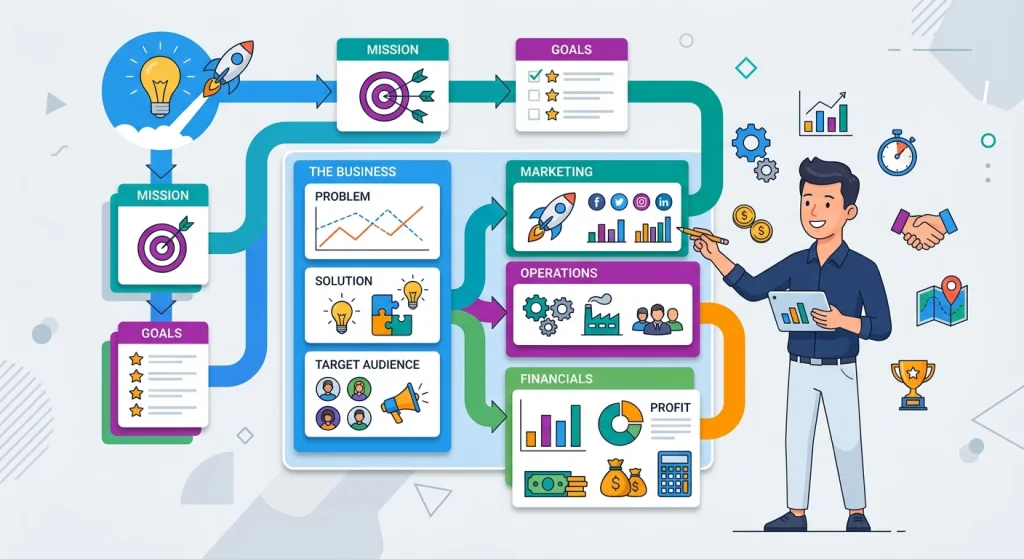
Let’s be real for a second. The words “business plan” sound about as fun as a root canal. You probably imagine a 50-page document full of complex spreadsheets, boring jargon, and projections that take a math degree to understand. But here’s the truth nobody tells you: For your first startup, you don’t need that monster document. You really don’t.
What you actually need is a simple, one-page roadmap. Something that fits on a napkin (or a single Google Doc). Think of it as GPS for your business: you wouldn’t drive across the country without knowing your route, right? So today, I’m going to show you how to create a simple business plan that takes 90 minutes, not 90 days. Let’s dive in.
Why Most First-Time Founders Get Business Plans Wrong
Firstly, most new entrepreneurs think they have to predict the future perfectly. Spoiler alert: you can’t. I’ve seen people spend six months building a detailed plan for a product that nobody actually wanted. Ouch.
On the other hand, flying completely blind is just as dangerous. You might spend $5,000 on Facebook ads before realizing your target audience hangs out on LinkedIn. A simple business plan isn’t a cage; it’s a flashlight in a dark room. It helps you ask the right questions before you spend your precious savings.
The Golden Rule: Your first plan should take less time to write than your morning coffee run.
The Lean Canvas Method: Your New Best Friend
Forget the traditional 50-page template. We are using the Lean Canvas. It’s the industry standard for startups because it focuses on problems, solutions, and key metrics—not theoretical fluff.
Here is the simple framework to follow. Grab a piece of paper or open a blank document. You will divide it into 9 boxes.
Box #1 – The Problem (What keeps your customer up at night?)
List your customer’s top three pains. Be specific.
- Bad example: “People need better food.”
- Good example: “Busy parents can’t find healthy, pre-cooked meals for under $10.”
Life Hack: Go read reviews on Amazon or Reddit for existing products. People literally write out their problems for free there. Use those exact words in your plan.
Box #2 – Your Solution (The aspirin, not the vitamin)
How do you fix those three problems? Don’t over-engineer this.
- Example: If the problem is “messy receipts for freelancers,” your solution is an app that scans receipts via phone camera.
Box #3 – Unique Value Proposition (The “Click Me” line)
You have 5 seconds to explain why your startup matters. This is your tagline.
- Real-life comparison: Uber’s UVP is “Push a button, get a ride.” Short. Sweet. Actionable.
- Your turn: “We sell vintage jeans for under $50 delivered to your door.”
Box #4 – Customer Segments (Don’t sell to “everyone”)
If you say your target market is “everyone aged 20-60,” you will fail. That is a lie we tell ourselves to feel safe.
- Narrow it down: “Working moms in Texas who shop on Instagram.” That is a real person. You can find her.
Box #5 – Key Metrics (The Dashboard)
How do you know you are winning? Pick 3 numbers.
- Examples: Daily app downloads, customer return rate, or average order value.
- The catch: If you aren’t tracking it, it doesn’t count.
The Money Section (Don’t Panic)
Okay, I know you clicked on this partly to figure out the cash stuff. Let’s keep it brutally simple.
Revenue Streams vs. Cost Structure – The Lemonade Stand Logic
Imagine you are 10 years old selling lemonade.
- Revenue Stream: $2 per cup.
- Cost Structure: $0.50 for lemons and sugar + $0.10 for the cup.
That is literally the same math for a tech startup or a clothing brand. For your simple business plan, just answer two questions:
- How do I get paid? (Upfront sale? Subscription? Freemium?)
- Where does the money go? (Rent? Software? Materials?)
Real-life example: A freelance graphic designer’s simple plan might be:
- Revenue: $500 per logo design.
- Costs: $20/month for Adobe, $50/month for internet. Profit = $430 per logo.
See? Not scary.
From Paper to Pavement: The 30-Day Sprint
You have your simple business plan written. Now what? This is where most people freeze. They want to make the plan “perfect” before they start. But here’s the truth: A good plan today is better than a perfect plan next month.
The “Smoke Test” Strategy
You don’t need a product to test your plan. You need a landing page.
- Example: If you want to sell handmade dog collars, build a simple “Coming Soon” page with a “Pre-order Now” button. Run $20 of Instagram ads. If 10 people click “Pre-order,” you have validation. If zero click, your plan needs tweaking.
Watch Out for “Zombie Planning”
This is when you update spreadsheets instead of talking to customers. It feels productive, but it’s actually just procrastination in a suit.
The 70/30 Rule: Spend 70% of your time executing (selling, building, talking) and 30% of your time planning.
A Real-World Comparison: Two Founders Walk Into a Bar…
Let me paint a picture.
- Founder A: Spent 4 months writing a 60-page business plan. Got funding. Realized on day one that their pricing model was wrong because they never actually asked a customer. They ran out of money fixing the plan.
- Founder B: Spent 2 hours writing a one-page Lean Canvas. Spent the next 4 weeks selling the product before it was built. When a customer said “I’d pay double for X feature,” Founder B updated the plan instantly. They launched profitably.
Which one do you want to be?
Your Simple Business Plan Checklist (Copy This!)
Before you close this tab, here is your actionable checklist. Print it out. Stick it on your wall.
- Identify the pain: Write down 3 specific customer problems.
- Name your solution: One sentence. Keep it stupid simple.
- Pick your audience: “Moms in Ohio” > “Everyone on Earth.”
- Set one financial goal: “Sell 50 units in month one.”
- List your channels: Where will you find customers? (TikTok? Cold email? Farmers market?)
- Define success: What number makes you happy? (E.g., 20% profit margin).
Conclusion: Your Move, Future Founder
Look, creating a simple business plan for your first startup isn’t about being a Fortune 500 CEO. It’s about being honest with yourself. It’s a living document that changes as you learn. You don’t need an MBA. You don’t need fancy software. You just need a clear head, a pen, and the courage to be wrong quickly so you can be right eventually.
Here is your Call-to-Action (Don’t skip this):
Stop reading and open a new note on your phone right now. Set a timer for 25 minutes. Fill out the 9 boxes of the Lean Canvas for your startup idea. When the timer goes off, send it to one friend who will be brutally honest with you.
That’s it. That’s your business plan. Now go build something cool.