
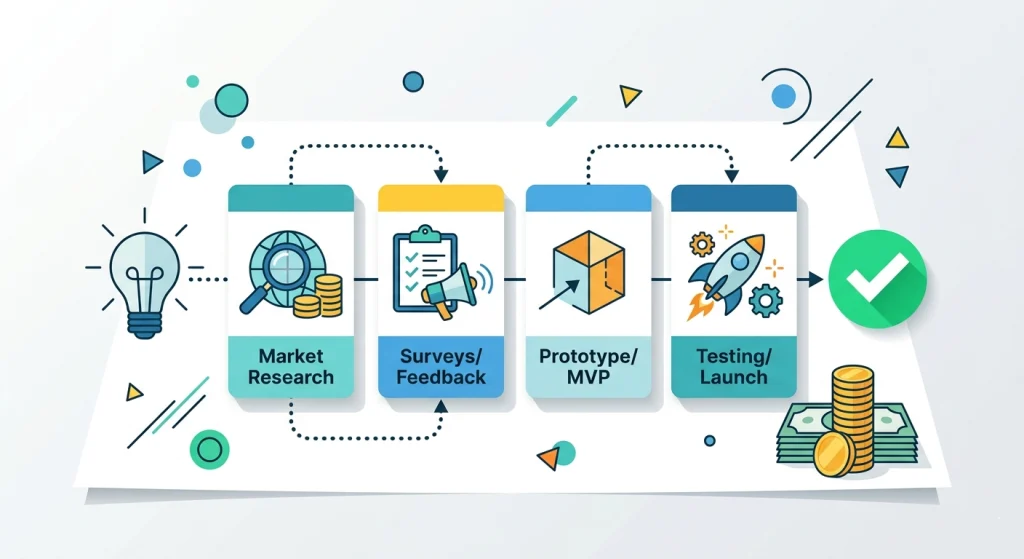
You’ve got that spark. That 3 AM idea that makes you want to quit your day job immediately. You can already see the logo, the website, and the beach in the background while you “work” from your laptop. Hold on. Let’s pump the brakes for a second.
I’ve been there. I once sunk two thousand dollars into organic dog treats because “everyone loves their dog.” Turns out, everyone loves their dog, but nobody wanted to pay premium prices for my specific biscuits. Ouch.
Here’s the hard truth: Most startups fail not because the product was bad, but because nobody wanted it. The good news? You don’t need to drain your bank account to figure that out. In this guide, I’m going to show you exactly how to validate a business idea before investing money—using cheap, sometimes free, real-world tactics.
Why Your Gut Feeling Is a Liar (And Data Isn’t)
We like to think we know what people want. But Steve Jobs quotes aside, you are not Steve Jobs. Your cousin who says “That’s a great idea!” is being nice, not honest.
The Trap: Enthusiasm feels like validation. It’s not.
To properly test a business concept on a budget, you need to separate your ego from the evidence. Think of your idea like a scientific hypothesis, not a baby. If the data says it’s ugly, you don’t protect it; you pivot it.
Step 1: The “Mum Test” Interview (Stop Asking Yes/No Questions)
If you ask, “Do you think this is a good idea?” people will say yes. It’s a reflex. Instead, you need to dig into past behavior.
The Life Hack: Ask about the last time they struggled with this problem.
- Bad question: “Would you buy an app that tracks your water intake?”
- Good question: “When was the last time you realized you were dehydrated? What did you do about it?”
Real-life example: A friend wanted to open a vegan bakery. Instead of asking “Do you like vegan cake?” (everyone likes cake), she went to a local coffee shop and counted how many people left with the one vegan muffin versus the regular croissants. The data was brutal. She saved $10,000.
Step 2: The Google Keyword “Eavesdrop”
Before you build anything, see if people are actively searching for the problem you solve. This is the cheapest market research ever.
Go to Google. Start typing your problem. See what autofills.
- If you type “How to remove…” and Google suggests “wine stain” but not “ketchup stain” (your idea), you have a demand issue.
- Use Google Trends. If interest in your niche is flatlining, it’s a dead end.
Fact: 70% of the search journey happens before a user clicks an ad. If nobody is typing in your core keywords, you are trying to sell umbrellas in a desert.
Step 3: Build a “Smoke Test” Landing Page (Cost: $0–$20)
This is my favorite trick. You don’t need a product. You need a button.
Create a one-page website using Carrd, Wix, or even a Notion page. Describe your solution as if it already exists. Add a “Get Started” or “Pre-order Now” button.
Here’s the catch: When they click the button, don’t take their money yet. Just take them to a page that says, “Thanks! We’re sold out for the beta launch. Leave your email.”
If 100 people click that button in a week? You have a winner. If 2 people click it? You have a hobby, not a business.
Life Hack: Run $50 of Facebook ads to that landing page targeting your ideal customer. If the Cost Per Click (CPC) is low but the email signup rate is high, you just validated your idea for the price of a pizza night.
Step 4: The “Fake Door” Test (Sneaky But Legal)
This works great for physical products or SaaS tools.
Go on Etsy or Gumroad. List your product as “Out of Stock” or “Pre-order.” If you are how to validate a business idea before investing money properly, you are simply measuring intent.
When someone tries to buy it, you message them: “So sorry, we sold out faster than expected! Can I put you on the waitlist for the next batch?”
Real-life comparison: Think of it like a movie trailer. The trailer costs way less than the film. If nobody watches the trailer, you don’t make the movie. Simple.
Step 5: The “Concierge” MVP (Do Things That Don’t Scale)
You don’t need an app. You don’t need inventory. You need one human volunteer.
Let’s say your idea is a meal planning service for busy dads. Don’t build the software. Go find three dads. Offer to do the meal planning for them manually via WhatsApp for $20/week.
- Why this works: You test pricing, value, and retention.
- The data point: Do they pay you again the second week?
If you dread doing the manual work, that’s fine—that just means you need automation. But if the customer doesn’t see value, no amount of automation will save you. This is the ultimate low-cost business idea validation method because your only expense is your time.
Step 6: The “Pre-sell” Challenge (Get Cash First)
This is the gold standard. Do not spend money on manufacturing or coding until a stranger gives you their credit card details.
- For products: Run a Kickstarter or Indiegogo pre-launch page.
- For services: Offer a “Founder’s Discount” for the first 10 clients at 50% off.
Example: A guy I know wanted to start a beard oil brand. Instead of ordering 500 bottles ($3,000), he made a simple video, posted it in a Facebook beard group, and said, “I’m making 50 bottles. First 10 pay $15, after that $25.” He sold 12 bottles in 4 hours. He used that cash to buy the supplies. Zero risk.
The Checklist: 5 Signs Your Idea is Validated
Before you write that check or swipe that business credit card, run through this quick checklist. You need at least 4 out of 5 green lights:
- Search Demand: At least 100+ monthly searches for your core problem keyword.
- Painful Problem: People you interviewed actually got emotional/annoyed talking about the issue.
- Click Intent: 10+ people clicked a “Buy” or “Start” button on your smoke test.
- Waitlist Growth: You have 20+ emails on a list without running expensive ads.
- Pre-sale: At least one stranger (not mom) has offered to pay you upfront.
What If Nobody Wants Your Idea?
First, breathe. It’s not a failure; it’s a pivot.
I had an idea for a travel backpack with a built-in phone charger. The smoke test failed miserably. Nobody clicked. But when I asked the 12 people who did look at the page what they wanted, they said, “I just want a backpack that doesn’t hurt my shoulders.”
So, I pivoted to ergonomic backpacks. That one worked.
The golden rule: Fall in love with the problem, not the solution. If you stay flexible, you never really lose money. You just buy information.
Conclusion: Stop Planning, Start Testing
Look, you can spend six months writing a business plan, or you can spend six hours doing these validation tests. One of those options costs you your dreams; the other costs you a Saturday afternoon.
How to validate a business idea before investing money comes down to one brutal question: Are you trying to be right, or are you trying to make money?
Your action step for today: Do not buy a domain. Do not design a logo. Just go ask three strangers (in a Facebook group or Reddit sub) one specific question about their biggest frustration in your niche. Reply to their comments. See what happens.
Your turn: What’s the idea you’re scared to test? Drop it in the comments below (just kidding—go test it right now).