
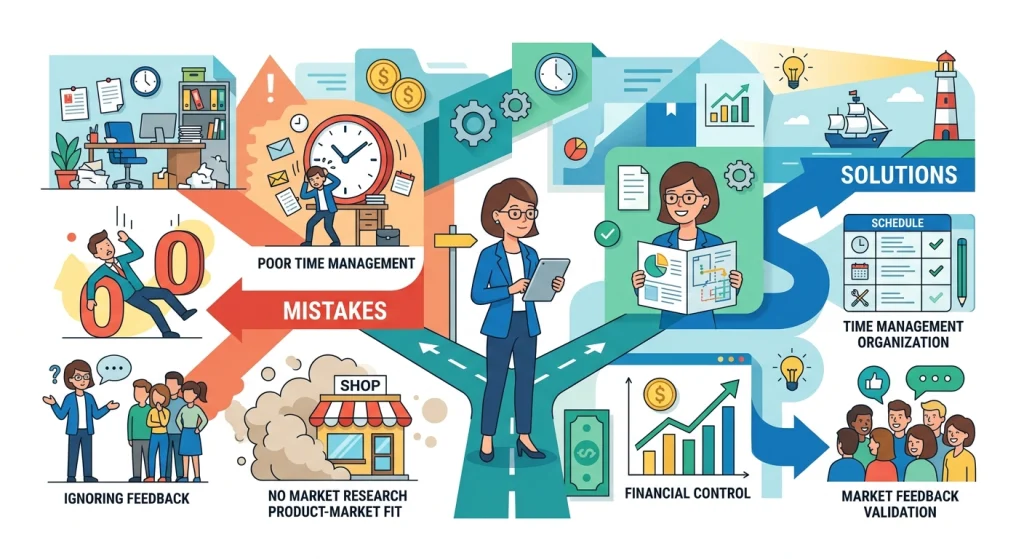
Let’s be real for a second—starting your own business feels a bit like jumping out of a plane and assembling the parachute on the way down. Exciting? Absolutely. Terrifying? You bet. But here’s the thing: most first-time founders crash not because their idea was bad, but because they keep tripping over the same hidden traps. The good news? You don’t have to learn everything the hard way. Let’s walk through the most common mistakes new entrepreneurs make, why they happen, and—most importantly—exactly how to dodge them like a pro.
Skipping Market Research (a.k.a. Falling in Love With Your Own Idea)
You’ve got that one idea. The one that keeps you up at night. You’ve already named your company, designed a logo in your head, and imagined the Instagram grid. But here’s the catch: nobody else might want it.
The “I Know My Customer” Trap
I’ve seen brilliant founders spend six months building an app… only to realize their target audience prefers calling over texting. Ouch.
Real-life example: Remember Google Glass? Sleek, futuristic, expensive. Google assumed we all wanted computers on our faces. Turns out, people felt weird, not cool. Lack of proper market validation cost them billions.
How to avoid it:
- Before you write a single line of code or order inventory, talk to 20–30 potential customers. Not your mom. Not your best friend. Real strangers.
- Use free tools like Google Forms, Reddit communities, or even LinkedIn polls.
- Ask one magic question: “What’s the hardest part about [their problem] right now?” If your solution doesn’t naturally come up, go back to the drawing board.
Trying to Do Everything Alone (The Superhero Syndrome)
Raise your hand if you’ve ever said, “It’s faster if I just do it myself.” 🙋♀️ New entrepreneurs wear every hat: CEO, accountant, social media manager, customer support, and janitor. But here’s what they don’t tell you in the motivational posts—burnout is not a badge of honor.
Why “Sweat Equity” Can Turn Into Sweat Tears
On one hand, bootstrapping is smart. On the other hand, spending three hours designing a logo when you could be closing sales? That’s just expensive procrastination.
Life hack: Use the $10/hour test. Ask yourself: “If I pay someone $10 to do this task, is my time better spent on something that grows the business?” If yes—delegate. Platforms like Upwork, Fiverr, or even a virtual assistant from OnlineJobs.ph can save your sanity.
Example: A friend who started a bakery chain spent her first year personally replying to every email at 11 PM. Eventually, she hired a part-time VA for $15/hour. Within two weeks, she freed 15 hours weekly—and revenue jumped 40% because she finally focused on wholesale deals.
Underpricing or Overpricing Right Out of the Gate
Pricing is emotional. New entrepreneurs either:
- Charge too little because they’re afraid of rejection (“Who am I to ask for $200?”), or
- Charge too much because they watched a guru say “premium or perish.”
Both hurt. Let me explain.
The Race to the Bottom Never Ends Well
If you price based on fear, you’ll attract bargain hunters who complain, churn fast, and leave bad reviews. Conversely, luxury pricing without luxury service creates refund requests.
Real comparison: Imagine two freelance graphic designers. Designer A charges $50 for a logo, rushes through it, and gets miserable clients. Designer B charges $500, spends an extra hour on research, delivers three concepts, and includes a brand guide. Clients feel valued. Word spreads. Who wins in six months?
How to find your sweet spot:
- Research three direct competitors. What are their price tiers? What do they include?
- Start with a “pilot price” 20% below your ideal. Test for one month. Raise prices until 20% of prospects say “it’s too expensive.” That’s your ceiling.
- Bundle value. Instead of lowering price, add something low-cost (e.g., a free checklist, quick support, or bonus template).
Neglecting Cash Flow (Even When Sales Look Good)
Here’s a scary truth: you can be profitable on paper and still go bankrupt. How? Cash flow timing. New entrepreneurs confuse “money in the bank” with “money promised later.”
The Invoice Illusion
You land a $10,000 client. Party, right? But they pay net-60, meanwhile your rent, software subscriptions, and freelancers are due now. Suddenly you’re borrowing from your credit card at 22% interest.
Classic example: Many product-based startups order $5,000 of inventory, sell half, reorder $5,000 more… then realize they never kept a buffer for slow months. One season of low sales, and they’re dead.
How to avoid the cash flow trap:
- Keep a rolling 3-month cash reserve. Start small: save $500, then $1,000.
- Offer a 5% discount for early payments (e.g., “pay within 7 days”).
- Use free tools like Wave or Pulse to forecast your cash flow weekly.
- Never, ever let accounts receivable exceed 30% of your monthly revenue.
Ignoring Marketing Until “The Product Is Perfect”
Perfectionism is just fear wearing a fancy suit. I’ve seen entrepreneurs spend 18 months tweaking their website font, convinced that once everything is just right, customers will magically appear. Spoiler: they won’t.
The “Build It and They Will Come” Myth
Field of Dreams lied to us. In reality, you need to market before you launch, during, and long after.
Life hack: Create a waitlist page with Carrd (free) or ConvertKit before you even build the product. Drive traffic with $5/day Facebook ads or Reddit posts in niche communities. If you can’t get 50 emails from interested people, your product might need a rethink.
Example: A SaaS founder I know launched with nothing but a Typeform survey and a Loom video explaining the idea. He got 200 signups in a week. By the time the software was ready, he had paying customers lined up. Marketing first. Product second.
Quick wins for marketing on day one:
- Start a simple blog (like this one!) answering customer questions.
- Post behind-the-scenes on TikTok or LinkedIn—people love imperfect, real journeys.
- Partner with micro-influencers (1k–5k followers) in your niche; they’re cheap and engaged.
Failing to Set Boundaries (Work-Life Blender Syndrome)
When you’re your own boss, it’s tempting to answer emails at 10 PM, work through weekends, and feel “always on.” But here’s the twist: that’s not hustle. That’s a highway to resentment and mediocre decisions.
Why Rest Is a Strategy, Not a Weakness
Research from Stanford shows productivity drops sharply after 50 hours of work per week. More hours ≠ more output. In fact, exhausted entrepreneurs make sloppy mistakes—forgetting to file taxes, mispricing contracts, snapping at clients.
Real-life comparison: Think of your energy like a smartphone battery. If you stay at 10% all day, your “apps” crash. But if you recharge to 90% daily? You process information faster, negotiate better, and spot opportunities.
How to protect your sanity (and your business):
- Set “office hours” even if you work from home. Communicate them clearly to clients.
- Use a separate phone number (Google Voice is free) for business. Turn off notifications after 7 PM.
- Schedule one “no-work” day per week. Seriously. I take Wednesdays offline for hiking—and my best ideas come during those breaks.
Not Tracking What Actually Matters (Vanity Metrics)
“We got 10,000 Instagram views!” sounds awesome. But did those views turn into sales? New entrepreneurs often obsess over likes, followers, and open rates while ignoring the numbers that pay the bills.
The Difference Between Feeling Good and Making Money
Vanity metrics = ego candy. Actionable metrics = real food.
Example: A boutique coffee roaster celebrated 5,000 newsletter subscribers. But only 2% opened emails, and 0.1% bought coffee. Meanwhile, their referral program (where customers got 15% off for inviting friends) drove 40% of revenue with just 200 participants.
What to track instead:
- Customer Acquisition Cost (CAC): How much do you spend to get one paying customer?
- Lifetime Value (LTV): How much does that customer spend over time?
- Churn rate: How many customers leave each month?
- Cash conversion cycle: Days between spending money and receiving it.
Free tool alert: Google Looker Studio (formerly Data Studio) lets you build simple dashboards. Or just use a spreadsheet with these three columns: “Metric,” “Target,” “Actual.”
Overhiring (or Underhiring) at the Worst Time
Growth is addictive. You get one good month, and suddenly you’re renting an office, hiring three people, and buying branded hoodies. But slow growth is sustainable growth. Fast growth without systems is like pouring gasoline on a campfire—you might get a flame, or you might burn the forest down.
The “First Employee” Test
Before you hire anyone, ask: “Can a freelancer, tool, or temp do this first?” If yes, do that for three months.
Real-life example: A subscription box founder hired a full-time customer support rep after hitting $20k/month. Six months later, she realized 80% of inquiries were about shipping delays—a logistics problem, not a staffing one. She switched to a chatbot + part-time VA, saved $3k/month, and fixed the root cause.
Smart hiring sequence:
- Automate (Zapier, ChatGPT, Calendly)
- Outsource (Upwork, Fiverr, Belay)
- Part-time employee
- Full-time only when step 3 is maxed out
Conclusion: Mistakes Are Tuition, Not Failures
Look, every successful entrepreneur you admire has a graveyard of screw-ups behind them. The difference? They didn’t quit. They learned, adjusted, and kept showing up. You will make mistakes. That’s okay. But now you’ve got a map of the biggest potholes—skip the research, ignore your cash flow, or chase vanity metrics? Not on your watch.
Your turn: Pick one mistake from this list that hit closest to home. Write it down. Next to it, write one tiny action you’ll take this week to fix it. Maybe it’s sending five DMs to potential customers. Maybe it’s setting up a free cash flow spreadsheet. Maybe it’s finally hiring that VA.
Ready? Go do that thing. And hey—drop me a comment or email when you do. I’m genuinely rooting for you.
P.S. If this article helped you, share it with another new entrepreneur who needs a friendly reality check. We rise by lifting others.